
Where to Put Bronzer for a Natural, Sun-Kissed Look
Wondering where to put bronzer for a natural, sun-kissed finish? Bronzer can add warmth to your complexion, enhance your features and give your makeup a healthy-looking glow. However, applying it in the wrong areas or using too much product can make your makeup appear patchy or uneven.
Understanding where to apply bronzer is especially helpful if you are new to makeup. You do not need complicated techniques or professional tools to achieve a beautiful result.
This beginner-friendly guide explains how to apply bronzer, choose the right shade and blend it correctly. You will also discover how to combine bronzer with blush and highlighter for a balanced everyday look.
Why Bronzer Placement Matters
Bronzer is designed to bring warmth to your complexion by creating the appearance of a gentle, sun-kissed glow.
Knowing where to put bronzer helps you enhance the areas of your face that naturally catch the sunlight. These usually include the forehead, temples and upper cheekbones.
Good bronzer placement creates a soft transition between your natural skin tone and the areas where you have added colour.
If you are unsure where to apply bronzer, begin with the outer areas of your face rather than applying it across your entire complexion.
The aim is not to change your facial features completely. Instead, use a little colour to complement your natural appearance.
Bronzer vs Contour: What’s the Difference?
Although bronzer and contour may look similar, they have different purposes.
Bronzer adds warmth. It usually comes in golden, bronze or neutral brown shades that create a sun-kissed appearance.
Contour adds definition. It is often cooler or more neutral in tone and is used to create the appearance of natural shadows.
Contour is commonly applied beneath the cheekbones or around the jawline. Bronzer is generally blended across areas that naturally catch the light.
Understanding this difference makes it easier to decide where to put bronzer without creating unwanted shadows.
Some neutral bronzers can provide subtle definition, but strongly orange-toned shades may look unnatural when used for deep contouring.
You can use both products together, provided their shades complement your skin tone.
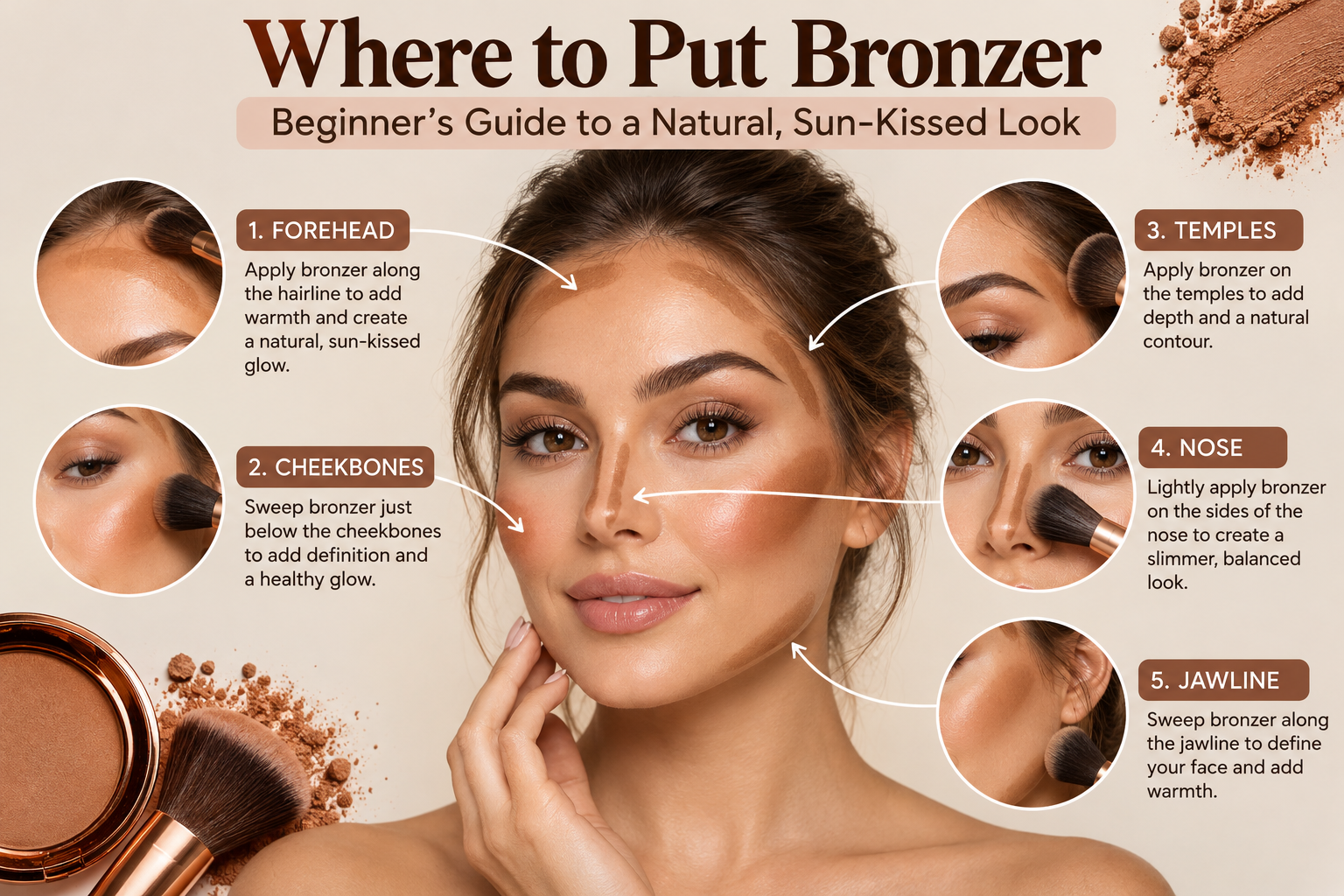
Where to Put Bronzer on Your Face: 5 Key Areas
If you are learning how to apply bronzer, these five placement areas are a useful starting point.
You do not have to use all five areas. A little colour on the forehead and cheeks may be enough for your everyday makeup.
1. Forehead and Hairline
The forehead is one of the easiest places to start when deciding where to apply bronzer.
Using a large, fluffy brush, sweep a small amount of bronzer along your upper forehead, following your hairline.
Keep most of the colour towards the outer edges and blend gently towards your temples.
If you have a smaller forehead, use less product to avoid making the area appear overly shaded.
A light application helps create warmth without leaving a noticeable line around your hairline.
2. Upper Cheekbones
The upper cheekbones are among the most important areas when considering where to put bronzer.
Start near the outer part of your cheekbone and blend the colour upwards towards your temple.
Use gentle sweeping movements rather than drawing a thick line across your cheek.
For a natural look, concentrate on the upper and outer cheekbones. You can adjust the placement slightly if you prefer additional definition.
Learning how to apply bronzer around the cheekbones helps you create warmth while keeping the finish soft and balanced.
3. Temples
Your temples connect the bronzer on your forehead with the colour on your cheeks.
If you are unsure where to apply bronzer around this area, use whatever product remains on your brush after working on your forehead.
Blend gently around the outer corners of your face using small, circular movements.
Avoid adding too much extra colour, as the temples usually need only a light application.
This creates a smoother transition between your forehead and cheekbones.
4. Bridge of the Nose
A light dusting of bronzer across the bridge of your nose can create a relaxed, sun-kissed appearance.
Use a smaller brush and apply only a tiny amount of product.
When learning how to apply bronzer around the nose, remember that this area needs much less colour than your cheeks.
Blend carefully to avoid creating a noticeable patch.
This step is optional, particularly if you prefer a more polished makeup finish.
5. Jawline
A little bronzer around the outer jawline can help create a smooth transition between your face and neck.
If you want to know where to put bronzer along your jaw, focus on the outer edges rather than applying a thick band beneath your chin.
Blend lightly downwards where necessary.
Avoid using bronzer to correct a noticeably mismatched foundation shade. Choosing the right foundation colour is a better starting point.
A subtle application is usually enough to complete the look.
How to Apply Bronzer: 5 Easy Steps
Now that you know where to apply bronzer, follow these five steps to achieve a natural-looking finish.
Step 1: Prepare Your Skin
Start with clean, moisturised skin. Apply your usual skincare products and allow them to settle before beginning your makeup.
If you are applying makeup during the day, include suitable sun protection in your skincare routine.
Apply foundation and concealer if you normally use them.
Cream and liquid bronzers can often be applied over liquid foundation before setting powder. Powder bronzer usually works better over a dry or lightly set base.
The correct order may vary depending on the products you choose.
You can explore the face makeup collection at Beauty Fusion for products to prepare your makeup base.
Step 2: Choose the Right Formula
Understanding how to apply bronzer becomes easier when you choose a formula that suits your skin type and preferred finish.
Powder bronzer: Often suitable for oily or combination skin, powder bronzer provides a soft finish and allows beginners to build colour gradually.
Cream bronzer: A good option for normal or dry skin, cream formulas can create a smooth, skin-like appearance. Apply with a brush, sponge or clean fingertips.
Liquid bronzer: Suitable for different skin types depending on the formula, liquid bronzer can provide a sheer or radiant finish.
Each formula behaves differently. Some blend best immediately after application, while others allow more time to work with the product.
Choose a texture that feels comfortable and complements your everyday routine.
Step 3: Select the Right Brush
The right brush can make a noticeable difference when learning how to apply bronzer.
For powder formulas, choose a large, fluffy brush with soft bristles. This helps distribute colour evenly without depositing too much product in one place.
For cream bronzer, a synthetic brush or damp makeup sponge can work well.
Use a smaller, tapered brush for precise areas such as your nose.
Keep your brushes clean and follow the manufacturer’s care instructions to avoid unwanted product build-up.
Step 4: Build Colour Gradually
If you are unsure where to put bronzer first, begin around your forehead or upper cheekbones.
For powder bronzer, gently tap excess product from your brush before application.
Sweep the colour onto your skin using light movements. Add another thin layer only if you want a warmer finish.
The best way to learn how to apply bronzer is to build colour slowly rather than applying a heavy amount immediately.
This gives you greater control and makes the finished result easier to adjust.
Step 5: Blend and Check Your Makeup
Blending helps bronzer look like part of your natural complexion rather than a separate layer of makeup.
Use a clean brush to soften visible edges around your forehead, temples and cheeks.
When deciding where to apply bronzer more precisely, checking your reflection in natural daylight can help you identify uneven areas.
If you have applied too much powder bronzer, gently buff the edges with a clean, fluffy brush.
For some cream formulas, a lightly dampened sponge may help reduce excess colour.
How to Choose the Right Bronzer Shade
Choosing a suitable shade is just as important as understanding where to put bronzer.
For a subtle finish, a shade approximately one or two tones deeper than your natural complexion can be a useful starting point.
Your skin’s undertone also matters.
Fair skin: Soft beige or light neutral bronze shades may provide gentle warmth without looking too orange.
Medium skin: Golden, caramel or warm brown shades can complement many medium complexions.
Deep skin: Rich bronze, copper or deeper brown shades can create beautiful warmth and definition.
These are general suggestions rather than fixed rules. Your undertone and preferred finish should guide your choice.
Test the colour in natural daylight whenever possible.
How to Apply Bronzer and Blush Together
Bronzer and blush can work beautifully together when applied in complementary areas.
Bronzer adds warmth, while blush brings a fresh touch of colour to your cheeks.
Begin by applying bronzer around the upper cheekbones and temples.
Next, place a little blush on the apples or upper part of your cheeks, depending on your preferred style.
When learning where to apply bronzer alongside blush, avoid concentrating both products heavily in exactly the same spot.
Blend where the colours meet so there are no harsh lines.
For a soft daytime look, neutral bronzer paired with peach or pink blush can create a balanced finish.
How to Use Bronzer and Highlighter
Highlighter can add radiance to your makeup by reflecting light on selected areas of your face.
Apply bronzer first, focusing on the forehead, temples and upper cheekbones.
Once you understand where to put bronzer, use a small amount of highlighter on the highest points of your cheekbones.
You may also apply a subtle touch along the bridge of your nose.
For natural everyday makeup, avoid using too much shimmer.
If you prefer a matte appearance, you can leave out the highlighter altogether.
Explore the makeup collection at Beauty Fusion for more everyday beauty essentials.
Bronzer Placement for Different Face Shapes
Face shape can influence where to apply bronzer, although personal preference is always important.
Round Faces
Apply bronzer around the temples and outer forehead. Blend upwards from the cheekbones to create the appearance of greater facial length.
Oval or Long Faces
For longer faces, a little warmth across the upper forehead can help create balance. Keep the cheek application soft.
Square Faces
Blend bronzer around the temples and upper cheekbones to soften the appearance of defined angles.
Heart-Shaped Faces
Focus on the temples and outer cheekbones. A light application can help balance the appearance of a wider forehead and narrower chin.
These suggestions are flexible. Experiment with different placements to see which approach suits your features.
Common Bronzer Mistakes to Avoid
Even after learning how to apply bronzer, small application mistakes can affect the result.
Applying Too Much Product
Heavy application can create dark patches.
Solution: Build thin layers and blend between applications.
Applying Bronzer Too Low
Strongly warm-toned bronzer applied too far beneath the cheekbones may create an unnatural-looking shadow.
Solution: For a sun-kissed finish, focus on the upper and outer cheekbones.
Choosing the Wrong Colour
A shade that is too dark or orange may stand out against your complexion.
Solution: Test your chosen shade in daylight and select one that complements your undertone.
Forgetting to Blend
Visible edges around the hairline or jaw can make makeup look unfinished.
Solution: Use a clean brush to soften the edges without adding more product.
Using Too Much on the Nose
The smaller surface area of the nose can become noticeably darker with excess product.
Solution: Apply only a light dusting using a small brush.
A Quick Everyday Bronzer Routine
If you want a simple routine, you only need a few basic steps.
Start with your foundation or usual makeup base. Choose a bronzer that complements your complexion.
Sweep a small amount across the upper cheekbones and gently blend towards the temples. Use the remaining colour around your outer forehead.
Once you know where to put bronzer, adjusting the amount for everyday makeup becomes easier.
Add a little blush for freshness, then check your finished look in natural daylight.
This quick technique is useful when you want warmth without spending too much time on your makeup.
Frequently Asked Questions
Where exactly should you put bronzer as a beginner?
If you are wondering where to put bronzer as a beginner, start with the upper cheekbones, temples and outer forehead.
These areas provide a natural-looking finish without requiring complicated application techniques.
Should bronzer go above or below the cheekbones?
For a sun-kissed look, bronzer is generally blended across the upper and outer cheekbones.
You can blend it slightly around the outer cheek area for extra definition, depending on your preferred finish.
Can you apply bronzer without foundation?
Yes. Bronzer can be applied directly over suitable skincare products.
Allow moisturiser and sunscreen to settle before applying your chosen formula.
Is powder or cream bronzer better for beginners?
Powder bronzer can be easier to control, particularly when applied with a fluffy brush.
Cream bronzer is also suitable for beginners who prefer a soft, skin-like finish.
How do you apply bronzer for a natural look?
When learning how to apply bronzer, choose a suitable shade, begin with a small amount and blend carefully.
Concentrate on the areas that naturally catch sunlight rather than covering your entire face.
Can you wear bronzer and blush together?
Yes. Apply bronzer around the outer cheeks and forehead, then add blush to the apples or upper part of your cheeks.
Blend the colours gently for a balanced finish.
How do you fix bronzer that looks too dark?
Use a clean, fluffy brush to soften powder bronzer. For cream formulas, carefully blend the excess with a suitable sponge.
Avoid adding more colour until you have assessed the result in natural light.
Final Thoughts
Understanding where to put bronzer can make your everyday makeup routine simpler and more effective.
Focus on the forehead, upper cheekbones and temples to create gentle warmth. Choose a shade that complements your complexion and take time to blend.
As you become more comfortable with how to apply bronzer, experiment with different formulas and placements to discover your favourite look.
Whether you prefer a subtle glow or a more defined finish, the goal is to enhance your natural features without making your makeup feel heavy.
Discover everyday beauty essentials in the Beauty Fusion UK makeup collection.
One Response